

Systematically improve your IT operations with Six Sigma for IT
Six Sigma for IT allows you to achieve higher quality and fewer errors in operational IT and support in a systematic way. Internal IT departments in both small and large corporations face a wide range of challenges. The most important are:
Improving reliability
Improving user experience
Increasing availability
Supporting business agility
Managing fragmented systems
Developing new technologies
Reducing operating costs
However, these efforts are hindered by a lack of resources and skilled personnel, as well as a lack of support from management. IT department teams spend over 50% of their time troubleshooting and maintaining systems, and over 80% want more scope for innovation and experimentation. These findings are confirmed by the Claranet Research Report 2019,"The Big Five: The Biggest IT Challenges for Companies in Europe".
When tackling these challenges, IT managers often choose linear models. For example, “more manpower equals more effectiveness” or “less budget equals more efficiency.” However, these equations are incorrect because they do not consider the actual causes and goals or only represent them in a simplified manner.
In industry and manufacturing, production processes are systematically and thoroughly optimized. These sectors face the same challenges as internal IT departments. As manufacturing becomes more digitalized, IT plays a critical role in a company’s competitiveness and is increasingly part of these efforts.
The DMAIC cycle
By applying Six Sigma to IT processes, data is measured and analyzed to develop targeted improvements. The project follows the DMAIC cycle:
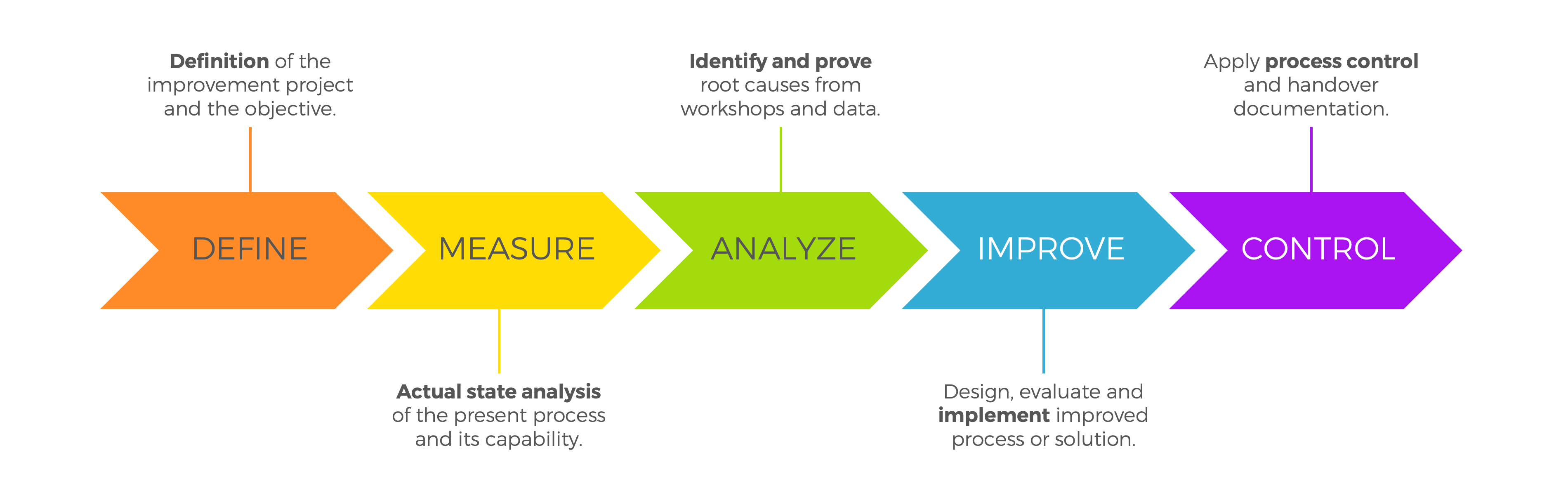
Define:
Define the problem and relevant metric.
Outline the business case and project objective.
Measure:
Calculate the current performance of the process.
Plan and carry out data collection.
Analyze:
Analyze the data and identify root causes.
Quantify the potential for improvement.
Improve:
Develop, evaluate, and implement solution options.
Test and refine the chosen solution(s).
Control:
Transition monitoring into a control process.
Document the project and its results.
Conclusion
Successfully conducting a Six Sigma improvement project in IT requires a solid understanding of information technology. Decisions are based solely on numbers, data, and facts, leaving no room for chance or subjective opinion.
Six Sigma for IT increases quality and reduces errors in IT’s day-to-day operations and support. It reduces staff workload and makes goal achievement measurable and visible. This, in turn, wins over executive leadership, turning them into Six Sigma champions.
Please also read my related article for Computerwoche: